
Updated: October 27, 2026
Recording the vows: ceremony audio at a Miami wedding, from the beach breeze to the church echo
Couples watch their wedding film for the pictures and keep it for the sound. Ten years on, it is the voice saying the vows, the officiant's words, the catch in a father's throat during the reading, that a family plays back. And ceremony audio is the part of a wedding film most often lost, because the ceremony happens once, in a place chosen for its beauty rather than its acoustics, with a breeze off the ocean, a fountain in the courtyard, a jet on approach to MIA, or a stone church that turns every word into a wash. This guide explains how a professional wedding video team records a ceremony in Miami: the microphones and where they go, the backups, the specific problems of beaches, gardens, churches and hotel ballrooms, and what a couple can do in the planning to make sure the words survive.
Why the DJ's feed is not enough
Most ceremonies have a small PA run by the DJ or the venue, with a wireless microphone on the officiant and perhaps a stand mic for readers. A video team can take a feed from that mixer, and should, but relying on it alone fails in predictable ways: the officiant's mic picks up the officiant, not the couple, who are speaking quietly to each other a metre away; the DJ mutes or adjusts levels at the wrong moment; the wireless system shares frequencies with the video team's own and one of them drops out; and the PA feed carries the room's reverb or the wind because the mic was never meant for recording. The feed is a backup. The primary sources are the video team's own microphones.
The standard setup
| Source | Placement | What it captures |
|---|---|---|
| Lavalier and recorder on the groom (or one partner) | Mic clipped inside the lapel or under the collar, recorder in the inside pocket; started before the processional, runs until the recessional | Both partners' vows and quiet words, the ring exchange, the kiss; the single most important track |
| Lavalier and recorder on the officiant | Under the stole or clipped to the collar; recorder in a pocket or on the belt | The service, the readings if the officiant is close, the pronouncement |
| Feed from the venue or DJ mixer | Line out to a recorder near the board, or a wireless hop | Everything through the PA: readers, musicians, the officiant's mic as a second copy |
| Camera-mounted or stand shotgun mics | On each camera, and on a stand near the front if it can be hidden | Ambience, applause, the sound of the room; a sync reference for every camera |
| Recorder near the musicians or the string quartet | A small stereo recorder on a stand, out of frame | The processional and recessional music in full quality |
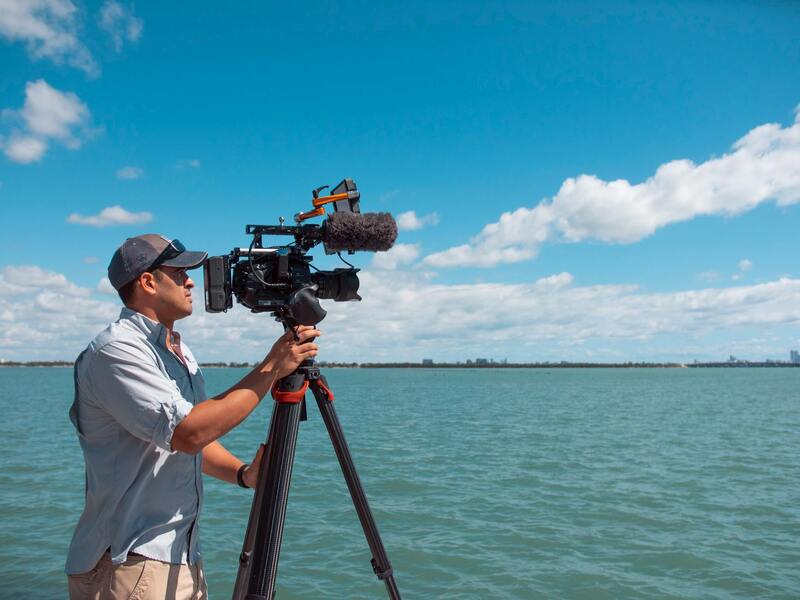
Everything records continuously and independently. No single failure loses the vows, and the editor chooses the best source for each moment. The two-videographer coverage we describe in our note on second shooter coverage also means a second person to place and check the microphones while the first is filming the getting-ready.
The bride's dress and the lavalier question
A microphone on the groom is easy to hide in a jacket. A microphone on a bride in a strapless or backless dress is not, and a wire down the back of a gown is not what anyone wants in the pictures. The usual solution is that the groom's lav, placed high on the lapel closest to where the bride stands, captures her vows at close range; a second lav on the officiant covers the other angle. Where the couple wear similar outfits, both can be miked. Some teams hide a tiny recorder in a bouquet; it works and it is worth a test at the rehearsal. For a same-sex couple in two gowns, or where neither partner has a jacket, plan the mics with the planner and the dressmaker in advance rather than on the morning.
Miami venues and their sound problems
- Beach. Wind is constant and directional. Lavs are covered with furry windshields even under a lapel; the officiant faces away from the wind if the setup allows; every recorder runs a low-cut filter. The surf is loud and beautiful, and the editor keeps it under the vows rather than trying to remove it. The rain and weather planning in our guide to rain plans for Miami outdoor celebrations applies to sound too: a sudden squall is a covered recorder, not a lost ceremony.
- Garden and courtyard. Fountains, traffic on the road behind the hedge, birds, and aircraft on the approach path. Ask the venue to switch the fountain off for the ceremony; most will. Schedule the vows for the quieter part of the flight pattern where the planner knows it.
- Church, cathedral, synagogue. Reverberation makes a distant mic useless; the lavs are everything, and the officiant's placement matters. Many houses of worship restrict where the video team can stand and whether microphones can be attached at all; the arrangements are made with the office beforehand, as our note on religious ceremony videography describes.
- Hotel ballroom and indoor venues. Air conditioning hum, catering activity behind the wall, a band setting up next door. The lavs handle it; the feed from the house system adds the readers; and a word with the banquet manager about kitchen noise during the vows is worth having.
- Rooftop and waterfront terrace. Wind again, plus boat engines and the city. Same approach as the beach, with the added issue that wireless microphones can suffer interference from the building's systems; a recorder on the person is more reliable than a wireless link to a camera.
What the couple can do
- Tell the videographer about the outfits early, so the microphone plan is made before the day.
- Allow ten minutes before the ceremony for the mics to be placed and checked; the best time is right before the groom walks out, away from guests.
- Ask the officiant to agree to wear a microphone, and to speak the vows at a normal volume, facing the couple, not the crowd.
- If you are writing your own vows, speak them, do not whisper them; the microphone is close, but the film is better when the words are clear. Practise once out loud.
- Give the video team the DJ's or the venue's contact so the feed and the wireless frequencies are coordinated before the day.
- Put the ceremony audio in the timeline as its own item, with the planner; our guide to building a wedding day timeline for video shows where.
Ceremony audio on the weddings we film
On every wedding and quinceañera we film in Miami, the ceremony is recorded from at least three independent sources: a lavalier recorder on one partner or both, one on the officiant, and a feed from the venue's system, plus shotgun mics on the cameras and a separate recorder for the musicians. Windshields and low-cut filters go on for anything outdoors, the microphone plan is agreed with the couple once the outfits are known, and the mics are placed and tested before the processional. In the edit, the vows are cut from the cleanest source, the ambience is kept under them, and the full ceremony audio is delivered alongside the film. If your ceremony is on a beach, in a garden or in a church with a long echo, tell us when you enquire and we will explain how we will record it; start on the contact page, and the way we cover a whole wedding day is on the about page.